Live music boosts New Orleans recovery after Katrina – note by note!
25th August 2025 · 0 Comments
By Geraldine Wyckoff
Contributing Writer
Soon after the devastation caused by Hurricane Katrina and the levee failures, trumpeter, vocalist and composer James Andrews performed at the New Orleans Jazz National Historical Park. It was there that Andrews famously declared: “We’re going to rebuild the city note by note.”
This performance marked the second time following the storm that he lifted his trumpet in his hometown. The first was alongside his brother, Troy “Trombone Shorty” Andrews, in a lit-up Jackson Square to an audience made up of politicians, dignitaries, contractors and the like.
A born leader with a powerful voice in the music and cultural community and beyond, Andrews still remembers his confidence in his words.
“I was watching our home underwater, it was a bad disaster, and I knew it was going to take New Orleans music to bring the city back – the spirit of New Orleans,” he says. “It was a united cause.”
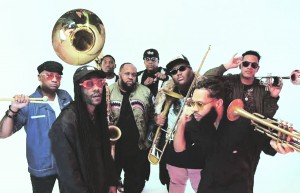
THE SOUL REBELS
“I knew the city of New Orleans was a strong place with cultural significance of music and jazz around the world,” he says. “It had to come back for the people.”
Andrews’ mission of keeping vital the musical and cultural traditions of the city, as well as the Treme neighborhood where he grew up, continues to this day. If, for instance, a culture bearer or a particularly much loved and respected person passes, it’s Andrews rallying the musicians and community to kick up a second line.
“I need to keep it alive to transfer it to the next generation,” he explains, citing the elders who influenced him, such as his grandfather, Jesse “Ooh Poo Pah Doo” Hill, Tuba Fats, Uncle Lionel Batiste and members of the Olympia Brass Band.
“I think it’s working out beautiful,” Andrews says of his traveling the world introducing New Orleans music to new audiences.
Let Your Mind Be Free Derrick Moss
The Soul Rebels’ anthem, “Let Your Mind Be Free,” describes in part what the band unconsciously and musically suggested the audience do when the group came back to New Orleans in the still dark days following Katrina to perform at Le Bon Temps Roule.
Derrick Moss, the bass drummer and an original Soul Rebel, remembers getting a call from Lumar LeBlanc, snare drummer and fellow founder, saying the woman who was booking Le Bon Temps Roule, a regular spot for the band, called him and said: “I don’t know where you guys are but can’t you please come home because we need y’all.”
“I said to Lumar, ‘Man, if they need us, we need them,’” says Moss, who was in Kansas at the time with the rest of the band members spread “all over America.”
The caller was Laura Vidacovich, who informed LeBlanc that the Magazine Street venue didn’t have power, only candles and ice chests full of beer.
While it’s long been acknowledged scientifically and through the human experience that music soothes the soul for many people, Moss wisely points out that in New Orleans it’s live music people need and are used to getting on a regular basis.
“Hearing a song on the radio is one thing but we (New Orleanians) want to be a part of it,” Moss offers. “It’s a full body experience. Everybody needed that thing that brings them peace and calm, and back to some normalcy.
“The first time we saw each other was at Le Bon Temps Roule; it was a big homecoming for us and then for the people, and then the music to the people. It was magnificent,” Moss says. “The block was filled with people cheering,” he adds.
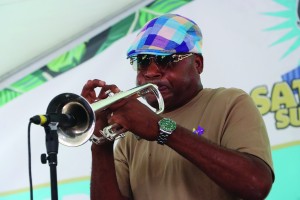
JAMES ANDREWS
Photo by Demian Roberts
“When we played ‘Let Your Mind Be Free,’ that’s exactly what happened. The audience went crazy and lost their minds.”
Let Your Mind Be Free Lumar LeBlanc
“For me, music is spiritual – the communicative nature of it,” says LeBlanc. “It’s my soul communicating with your soul. It’s just an intangible entity and it’s the highest form of sharing that I can personally give another being. It’s my art, my prayer. Katrina made us appreciate the music even more and not take it for granted. When I touched that drum again, I loved it as much as I could.”
“To me, it was frightening to know that everything could have been lost with that storm,” LeBlanc continues. He describes his experience that first, dark mid-October night playing with the entire band onboard at Le Bon Temps Roule as having an “epiphany,” an awakening of sorts.
“Emotionally I wasn’t prepared to see the devastation of the city yet,” he admits, “but the music felt so good and it warmed my soul.”
Another significant anthem provided by the Soul Rebels during the “Katrina era,” was its song “504” – New Orleans’ area code. It’s difficult to explain to those not from the Crescent City how excited people who were living away from their beloved hometown to see those three numbers pop up on their phones.
When they played it, hands would go up, and still do, gesturing the numbers – five fingers, clinched fist and then four fingers.
LeBlanc evacuated to Houston, Texas, and has remained there “commuting” to New Orleans at first by truck and now either flying or taking the bus along with trumpeter Marcus Hubbard to make the band’s regular Thursday night gig at the Le Bon Temps Roule.
“The music was healing and provided emotional support – a mental break from all the chaos,” LeBlanc says, describing Le Bon Temps Roule at the time as an “island” or “oasis” that will be forever appreciated.
“Jazz City” Will Swing Again
The late George Brumat owned Snug Harbor Jazz Bistro when Katrina hit and quickly took up residence in the building. His optimistic sign about New Orleans swinging again caught the eyes of many passers-by and surely gave some a little lift.
Jason Patterson, the club’s current owner, believes that with his presence at the Frenchmen Street locale and the poster in the window, George displayed his protective nature to all of New Orleans.
With some talk of New Orleans not worth rebuilding, Patterson remembers that folks here were very desperate to know that there would be some future in this town. “Any live music that was provided, that was super important and the people would flock toward events,” he says, adding that the club initially presented a “one-off” show.
“They (audience members) were crying, they were so relieved that there was some glimmer of hope that things would come back.”
In mid-October 2025, a full-powered band with fretman Don Vappie, drummer Ricky Sebastian, saxophonist Ed Petersen and guitarist Steve Masakowski took the stage from 3 p.m. to 6 p.m. on a Friday evening.
“From my perspective, just the idea of being able to play in New Orleans again was a benefit because I had been away since Katrina hit,” says Vappie who had performed at a festival in Maine and was working his way back. Yearning for a taste of New Orleans, Vappie even took a side trip to hear saxophonist Branford Marsalis and Harry Connick Jr. simply to see someone from New Orleans and hear the spoken and musical dialect of the city.
“Live music by New Orleans artists was the tip of [the] iceberg in the cultural renaissance that happened in town,” Patterson opines.
During those dark early days following Hurricane Katrina, illumination came not from the street lights overhead but the sound of horns, drums, voices, guitars and more of New Orleans home grown music. In the midst of live music, for a little while, to paraphrase Derrick Moss, “We got to forget all that we had lost.”
This article originally published in the August 25, 2025 print edition of The Louisiana Weekly newspaper.