
Rep. Jeffries faces growing discontent from Black constituents
6th October 2025 · 0 Comments
By Stacy M. Brown
Contributing Writer
(Black Press USA) — When House Democratic Leader Hakeem Jeffries and Congressional Black Caucus Chair Yvette Clarke were honored at the Black Press of America’s annual Leadership Awards, anticipation filled a packed ballroom. Black journalists, publishers, and community leaders were gathered to celebrate an institution that has carried the voice of African Americans for nearly two centuries. Civil rights attorney Ben Crump delivered a passionate pledge of $50,000 to keep the Black Press alive, urging others to follow suit. But Jeffries and Clarke never appeared. Though only steps away, they did not come to receive the honor or to offer even a two-minute acknowledgment. For the Black Press, battered under the current regime and just eighteen months away from a historic bicentennial, the snub cut deep. “Typical of Democrats,” one person said inside the event ballroom. “They don’t spend money with us. They don’t show up. And then they expect us to deliver their message for free.”
A Growing Rift
The absence has crystallized what many Black Americans have long sus
pected, that party leaders, even when they share the community’s skin color, are not necessarily accountable to the community itself. Jeffries recently hosted a private, off-the-record conversation with select Black journalists, but his on-the-record interviews tend to be reserved for white and mainstream outlets.
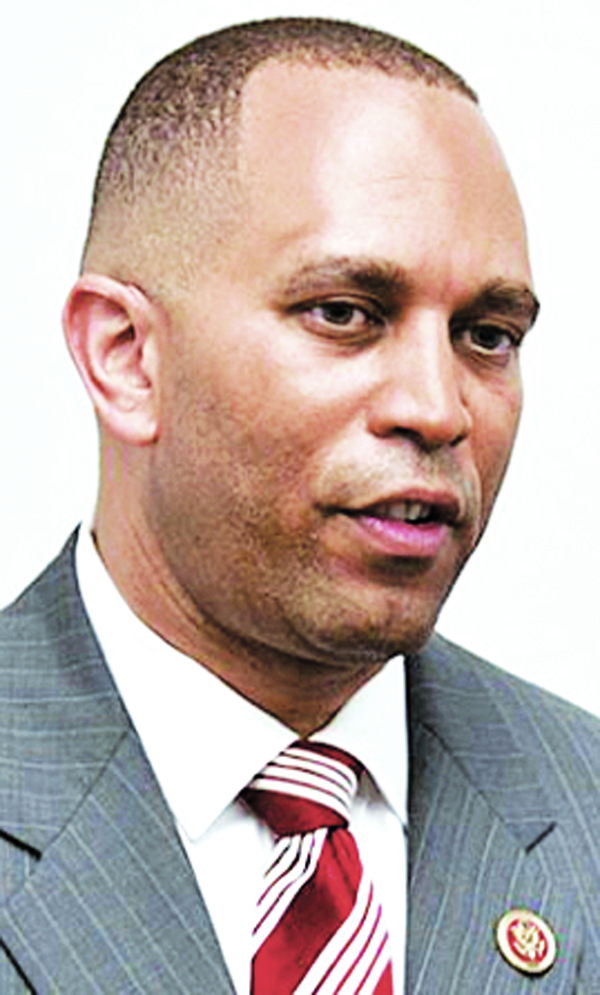
For some, this is part of a pattern in the Democratic Party of avoiding serious investment in Black-owned media while pouring resources into corporate networks. The disillusionment is not new. In a July poll, only 33 percent of Americans approved of Democrats in office, the lowest rating for the party in three decades. Charlamagne Tha God gave voice to the frustration on his nationally syndicated show, charging, “Hakeem’s a puppet. Hakeem’s not doing anything if Chuck Schumer don’t tell him to do it. And it’s simple as that.”
He mockingly nicknamed Jeffries “AIPAC Shakur” in reference to his support from pro-Israel donors.
Criticism from Within
The skepticism extends beyond activists and commentators. Ashley Etienne, a veteran strategist who once ran Nancy Pelosi’s anti-Trump war room, described Jeffries’ leadership as deficient. Speaking to Politico, she said, “Trump is just giving us all this incredible red meat … I’ve never seen anything like this before. It’s like the biggest gift any party has been given by the opposition and we’re just squandering it,” pointing squarely at Jeffries.
Etienne accused him of failing to build a coordinated national strategy and of deliberately rejecting the guidance of Pelosi’s experienced team. “I was hearing from leadership staff that the leadership on Capitol Hill right now wants to sort of move away from that Pelosi era – that they… don’t want to embrace anyone or anything that’s like Pelosi,” she said. “Which I just think is the dumbest s-h-i-t ever.”
A Record Under Scrutiny
Questions of integrity also follow Jeffries. For years, he claimed he had only a “vague recollection” of the controversies surrounding his uncle, Professor Leonard Jeffries, who was ousted after incendiary comments about Jewish people. Yet a CNN KFile review found that as a college student, Hakeem Jeffries defended his uncle and Louis Farrakhan in an editorial, writing that they were victims of a “media lynching” by the “White media.”
His office insists his career demonstrates he does not share those views, but the contradiction has added fuel to the perception that he adjusts his narrative to the moment.
The Burden of Being First
Jeffries is also navigating the reality of being the first Black lawmaker to lead a party in Congress. TIME magazine noted that being a “first” often comes with heightened scrutiny and constrained possibilities. Leaders who break racial barriers are frequently chosen because they can build consensus, but critics argue that too often this looks like accommodation.
Historian Komozi Woodard described Jeffries as “an heir” of the movement that once sought to wrest power from within the Democratic Party, but warned that being elevated in crisis can make true success elusive.
Facing Trump’s Attacks
If Jeffries has been measured in his dealings with progressives, he has been defiant in confronting Donald Trump. Just days ago, Trump posted a racist, AI-generated video depicting Jeffries in a sombrero and mustache while mocking his positions on immigration and healthcare.
Jeffries responded on social media: “Bigotry will get you nowhere. Cancel the Cuts. Lower the Cost. Save Healthcare. We are NOT backing down.” At a rally at the Capitol, Jeffries tried to project strength, telling a crowd: “We don’t work for Donald Trump. We don’t work for JD Vance. We don’t work for billionaire donors. We work for all of you, the American people. … Healthcare must be a right available to every single American at all times.”
He called on Democrats to “hold the line” and promised, “We’re in this fight until we win this fight.”
A Community Still Waiting
Yet those words, powerful as they may sound, ring hollow to many Black Americans who watched him ignore the very community that has historically defended democracy through the darkest times. From slavery through Reconstruction, Tulsa, Jim Crow, and the Civil Rights Movement, the Black Press has been at the center of resistance and survival. That history makes Jeffries’ absence at the Black Press gala sting all the more. Trump may target him with racist images, but the more piercing critique comes from within his own base: that when his community calls, he does not answer.
One Black publisher left the ballroom that night with a blunt assessment: “Our ancestors built this press through every trial in this country. The least Hakeem Jeffries could do was show up.”
This article originally published in the October 6, 2025 print edition of The Louisiana Weekly newspaper.