
‘Second Line Sunday’ rolls
8th September 2025 · 0 Comments
By Geraldine Wyckoff
Contributing Writer
“Second Line Sunday,” the latest album released by the collaboration of Troy “Trombone Shorty” Andrews and the New Breed Brass Band, led by his nephew Jenard Andrews, dropped on August 29, the 20th anniversary of Hurricane Katrina.
Considering the date, one might have expected it, in some way, to reference the storm and the devastation caused by the failure of the levees.
Not so with the upbeat, all for one, feet stomping album which looks back to the vibrancy of Black street traditions and forward to their future.
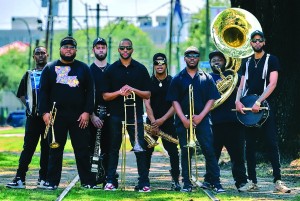
Trombone Shorty and the New Breed Brass Band
“The album is a celebration of everything we thought we lost,” says Trombone Shorty, who describes himself as “as always optimistic.” “Me, personally, I never wanted to write music about Katrina as I never wanted to be reminded of a terrible, disastrous time,” he continues, saying that he, like everyone from New Orleans, didn’t know what the future would hold. He also realized that, as he puts it, “the musicians that play the music, we would always carry it around.”
Jenard points out that there was definitely concern that there might never be enough musicians returning to New Orleans to carry on this city’s music around the world. “So we wanted to acknowledge, celebrate and pay homage to the culture,” he whole-heartedly offers.
On “Second Line Sunday,” they satisfy that goal on a slate of self-penned material. “We’ve never recorded a song that we already played,” Jenard informs.
Jenard’s rousing snare drum sets the celebratory beat on the album’s opening cut, “Line Em Up,” co-written with Trombone. The drummer’s approach at the start, and later during a solo, is all “street,” yet brightened by a certain sophistication further evolved under Trombone Shorty’s guidance and insistence on discipline. He’s paired well here and throughout with bass drummer Roderick Andrews.
Here comes Troy, blowing trumpet big time with his solo punctuated by, again, a well-trained, stop-on-a-dime horn section.
To accomplish that clean and tight polish, so necessary in the studio, is partly a matter of breathing, Troy explains. “We want to cut the notes off exactly at the same time – at a particular breath. On the street,” he adds with a laugh, “breathing is a matter of survival.” Troy calls the snare drum on the street the “battery pack” while in the studio it requires restraint and melody awareness.
“I’ve been able to bring that discipline of making an album and not just playing live like on the street or the Candlelight (bar),” says Troy, who credits his time 20 years ago in Lenny Kravitz’s band and observing the master musician’s demand for excellence. Troy also praises the growth in musicianship of Jenard and the members of the New Breed Brass Band since its previous studio album, the Grammy-nominated “Made in New Orleans.”
New Orleans street culture’s embrace extends throughout the Black community and beyond the brass bands and social aid and pleasure clubs’ Sunday afternoon second lines. The centuries old Black Indian tradition and the vigorous hip-hop scene are one with the community and are represented on “Second Line Sunday.”
A fun example of modern brass style meets rap on the street is “Rock the Boat,” a groove of a tune with lyrics relevant to New Orleans enhanced by both Troy’s soulfully, melodic singing and a hip delivery of rap by Gussy Corleone.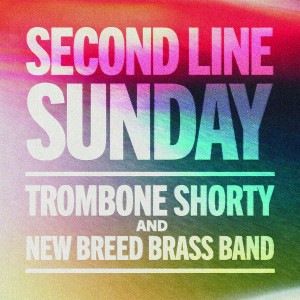
On “Way Downtown,” Big Chief Romeo Bougere of the 9th Ward Hunters takes over telling the stories of past Mardi Gras days and his and his gang’s strength and triumphs. The New Breed horns, which provide the response to his calls, are a natural addition to the Black Indian chants that are usually accompanied simply by drums and vocals of an Indian “rhythm section” that supports the chief.
The big sound of the recording was purposeful and produced by the eight musicians making up the “core band.” It got a boost from musicians, family and friends coming around the studio who were recruited to make up what’s known on second lines as the “third line.”
“The third line to us is the people who are picking up (and playing) bottles, tambourines and cowbells,” Troy explains, adding that he also calls the group a “hand clap orchestra.” “We wanted to create the atmosphere of the street,” he says.
Jenard quickly jumps in to remind his uncle about those who “play” a stop sign as another percussive element. “All of that stuff makes the vibe better and it gives you more to feed off.”
“The song ‘6th Ward’ has that all over it with people hitting coffee mugs and microphone stands with drum sticks,” says Troy about the cut he wrote on which the strong tuba playing of Michael Brooks holds it all together.
When Troy, 39, describes the session as “a family affair,” in a sense he’s being literal – four members of the Andrews family fill the band’s ranks. Beyond himself and Jenard, 34, who also plays with Rebirth Brass Band, there’s trombonist Revon Andrews, the son of trombonist Revert “Peanut” Andrews, and a second cousin, Roderick Andrews, who Troy calls “one of the most exciting young bass drum players.”
A next generation of musicians outside of the Andrews clan is also represented in the likes of saxophonist Orlando Gilbert, the son of the recently departed saxophonist John “Prince” Gilbert. Orlando is a New Orleans Center for the Creative Arts (NOCCA) graduate who studied at the Berklee School of Music and came home to play alongside his father.
“I told Orlando, ‘Your dad raised me in the music,’” Troy remembers. “I played alongside of him in New Birth and it’s a full circle that I am able to have you be with me in New
Breed and (Troy’s band) Orleans Avenue.”
Undoubtedly, other family members were present at Troy’s Buckjump Studio during the recording. In spirit, Troy’s mother and Jenard’s grandmother, the late Lois Andrews Nelson, a huge presence on the street as a second liner, grand marshal and baby doll, to whom the album is dedicated was there in spirit too.
“Second Line Sunday” celebrates the legacy of the Black street culture and how, in New Orleans, music is passed on through generations.
“I teach them and learn from them too,” says the always generous and loving Troy “Trombone Shorty” Andrews of his nephew Jenard, the members of the New Breed Brass band and youngsters coming up in the community. “They’re going to keep me going.”
This article originally published in the September 8, 2025 print edition of The Louisiana Weekly newspaper.