
Was Louisiana’s ‘energy boom’ a jobs bust?
27th April 2026 · 0 Comments
By Halle Parker
Contributing Writer
(Veritenews.org) – In the early 2010s, an explosion in natural gas development, combined with relatively high fuel prices, kicked off a new boom in massive, multibillion-dollar investments in new Louisiana petrochemical and energy developments. A 2014 report by The Data Center, a New Orleans-based nonpartisan nonprofit that analyzes economic and demographic trends, projected that the “transformative” development would lead to a “tidal wave” of jobs.
But more than a decade later, a new Data Center analysis found that the number of jobs in Louisiana has instead flatlined, despite $90 billion in capital investment across the energy and manufacturing sectors. The number of jobs grew by .18 percent from 2015 to 2025, compared to a ten percent average growth rate nationally. The state also experienced 30 percent more toxic spills in the same timeframe, and state residents suffered poor health outcomes – high rates of heart attacks, lung disease, strokes and serious pregnancy complications – likely related, in part, to pollution.
The boost in investment also coincided with population decline in the state. Though a temporary boost in short-term construction jobs buoyed the state ahead of the 2020 crash during the COVID-19 pandemic, the market for permanent, local jobs has declined. The Data Center Chief Demographer Alison Plyer said the lack of job growth likely contributed to the state’s decline in population.
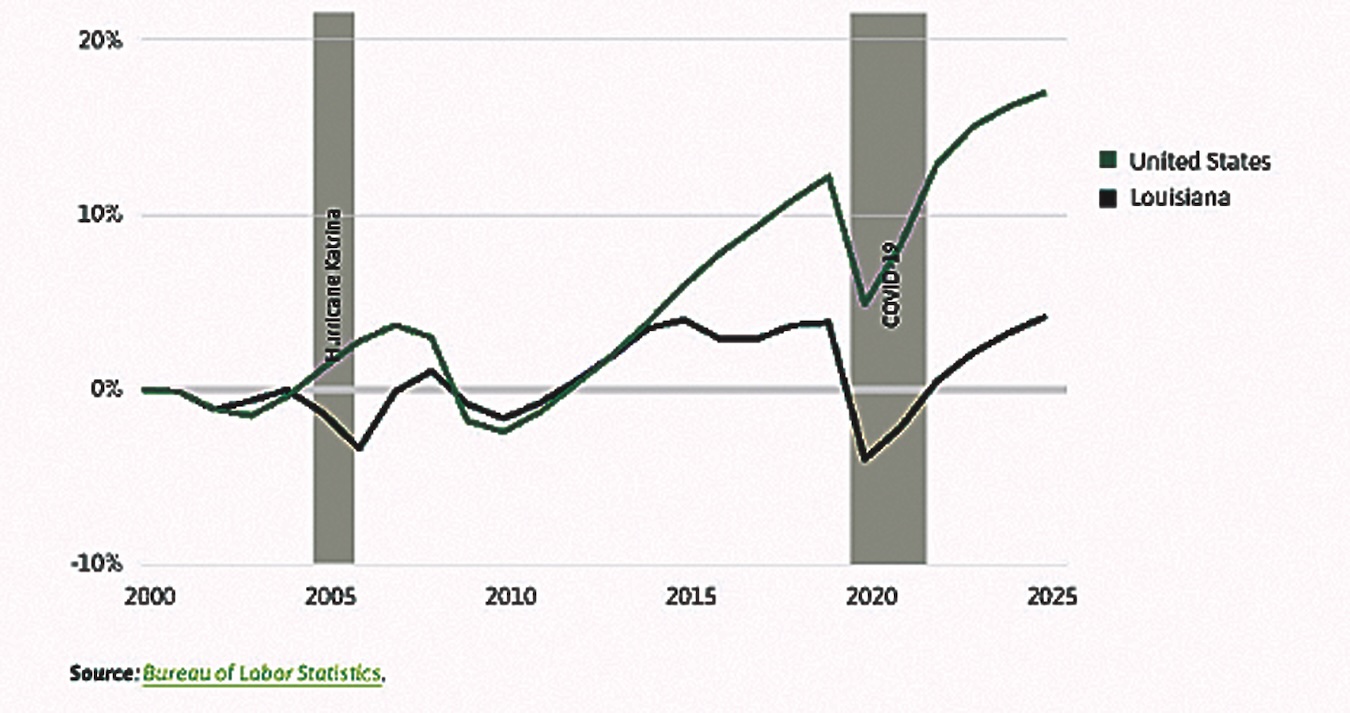
“That capital came, a large number of plants were built in various parts of the state, and yet the state actually started to lose population around that timeframe,” Plyer said.
After her team saw that job growth was flat over the last decade, she said the population loss was “no surprise.”
“But big surprise that we’re not growing jobs given this massive investment,” she said.
Dow Chemical Company spent $2 billion on a pair of polyolefins plants in West Baton Rouge and Iberville parishes that opened in 2017. Several U.S. and Japanese companies invested $10 billion to build Cameron LNG in southwest Louisiana. Venture Global LNG built another $10 billion export facility nearby that opened in 2021.
Data from the U.S. Bureau of Labor Statistics shows that Louisiana still has the highest concentration of refinery and chemical manufacturing jobs in the country. But Plyer said those facilities have diminishing returns as they increasingly invest in automation and hire fewer workers. Instead, the state’s healthcare industry has seen the most job growth in the past decade, though that progress has been threatened by recent changes to Medicaid funding.
As state officials approve large incentives to usher in another $100 billion wave of capital investment – through new liquefied natural gas export facilities, data centers and chemical manufacturing plants – Plyer said the Data Center report calls into question whether these investments will improve the quality of life for residents and stop them from leaving the state.
“Leaders need to think twice about incentivizing large corporations that are not held accountable for actually producing jobs,” Plyer said. She noted that the companies could also be required to install existing technologies that limit and monitor emissions to better protect the health of residents.
According to The Data Center’s report, Louisianians are 36 percent more likely to have a stroke than the rest of the country and rank second in the nation for the number of babies born at dangerously low birth weights. These health issues have been linked with exposure to toxic air pollution, which the state also ranks in the top percentiles. In 2017, the state faced the highest risk of cancer in the nation from air pollution.
“In every parish in the state, there are industrial sites that are releasing toxins that are hazardous to humans,” Plyer said.
The Louisiana Chemistry Association – a powerful trade group representing the state’s petrochemical manufacturing companies formerly known as the Louisiana Chemical Association – did not respond to multiple requests for comment. The Louisiana Oil and Gas Association, another trade group, also did not respond to a request for comment in time for publication.
Lake Charles resident James Hiatt used to work for a petrochemical plant before starting his own environmental nonprofit, For a Better Bayou. He still has family members who work in the industry, and he said they’ve seen hiring slowed as automation has grown more prevalent. At the same time, he said the few workers on hand are asked to work longer shifts instead of hiring more staff.
“When I worked out there … somebody would call in sick. You wouldn’t have enough people to cover,” Hiatt said, recalling 18-hour shifts at times. “This is the system that we live in to maximize profits and in order to do that, they’re very happy to cut the labor force.”
The permanent jobs that exist pay very well, Hiatt said. But he felt there aren’t enough for the number of qualified engineers coming out of Louisiana colleges. Calcasieu Parish felt the “energy boom” with more than 4,000 construction jobs in 2018 with the arrival of a new LNG facility. The number of staff dropped closer to 300 jobs since the facility was built, as of 2022.
“The promises of jobs, the promises of prosperity never actually get delivered. There is a short burst of economic benefits during construction,” Hiatt said.
Jan Moller, executive director of Invest in Louisiana, said the tax revenue benefit of these multibillion dollar investments are also limited. Invest in Louisiana is a nonpartisan think tank based in Baton Rouge that focuses on economic policy. Louisiana’s generous Industrial Tax Exemption Program no longer requires job creation or retention under an executive order from Gov. Jeff Landry, and most facilities that participate in the program are only required to pay 20 percent of their property taxes for 10 years.
“When we don’t make them pay property taxes, that is a gift we’re giving to the shareholders of that corporation,” Moller said. “ If somebody’s gonna come in to your community and make a massive investment into a plant that will produce a lot of pollution then they should at least pay the property taxes on that investment.”
Plyer and Moller said residents should pay attention to how many jobs are actually created permanently by the facility itself, rather than the temporary construction jobs and the idea of “indirect” job creation through the company’s investment.
“We have to really start to look at metrics that are closer to home,” Plyer said. “Did it produce jobs? Did it increase income? Did it improve well-being? These metrics are a cautionary tale.”
This article originally published in the April 27, 2026 print edition of The Louisiana Weekly newspaper.